
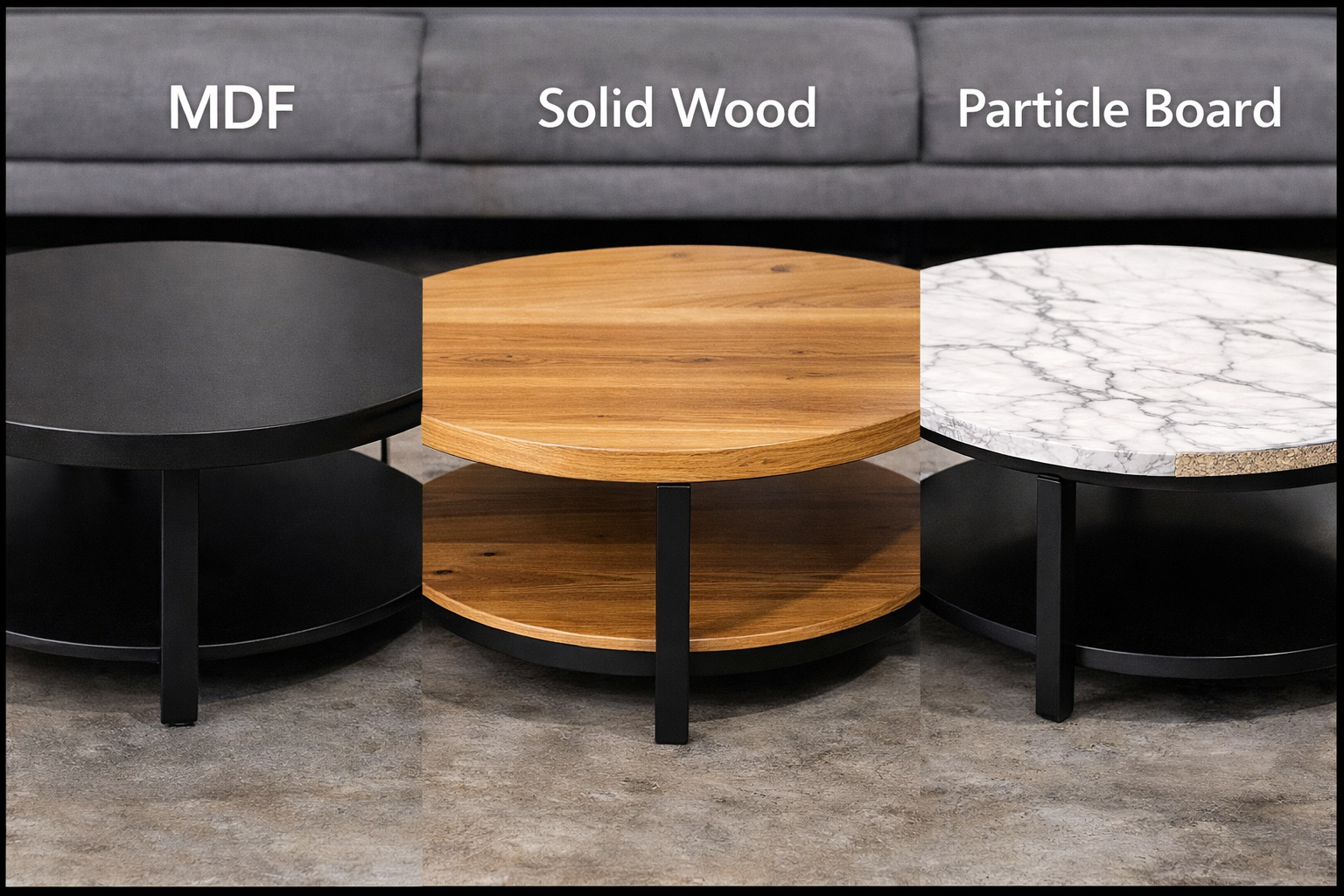
Why Material Choice Matters for Coffee Table Products
Material selection directly affects the market positioning of a coffee table.
For example, a round coffee table designed for online retail must balance:
*structural strength
*shipping weight
*cost competitiveness
*modern aesthetics
A black coffee table using MDF panels and powder-coated steel legs can reduce production costs by 20–30% compared with a solid wood structure.
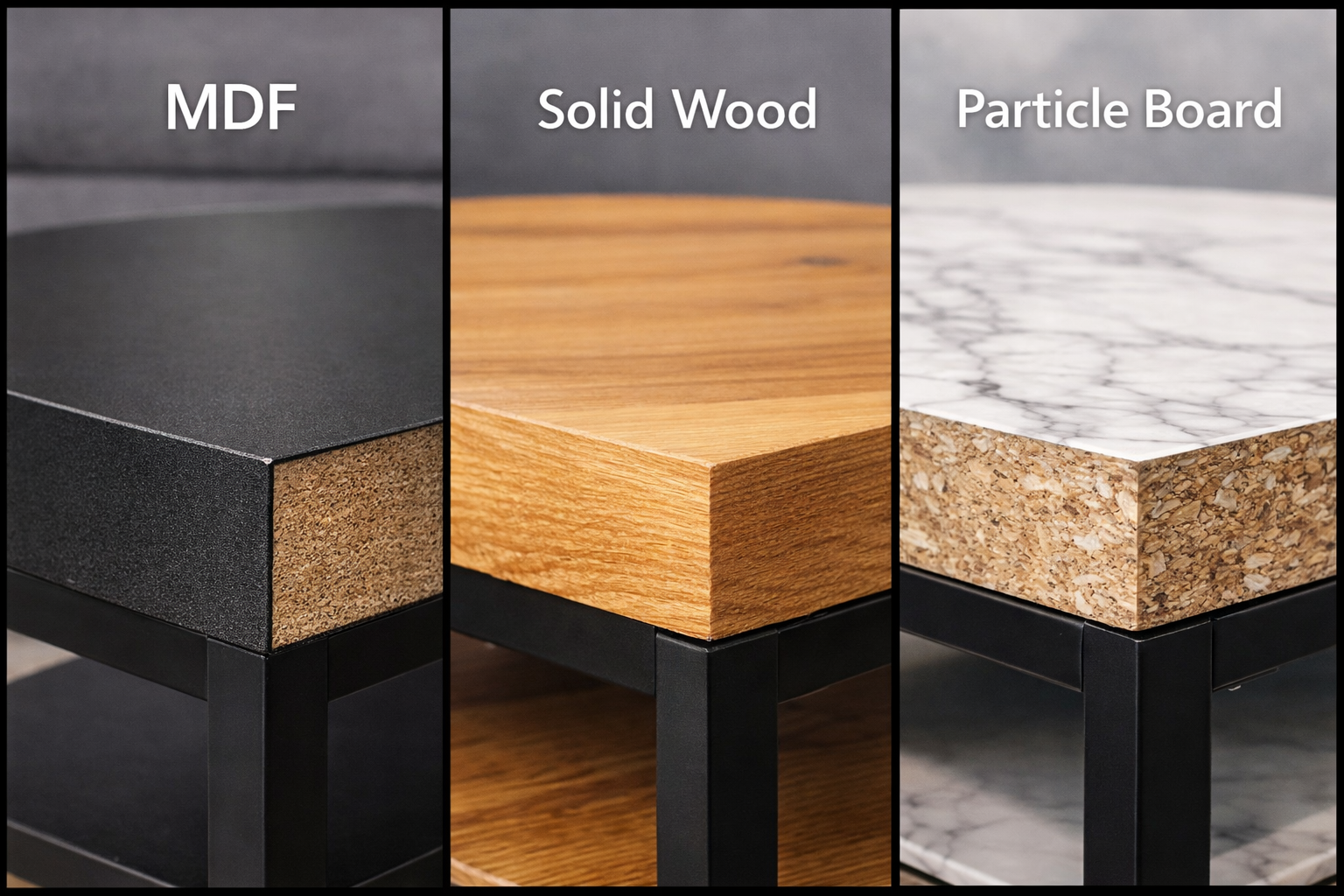
Similarly, many marble coffee table products use marble-pattern laminate instead of natural stone, reducing weight by 40–60% while maintaining the same visual appeal.
For importers and Amazon sellers, this balance between design and logistics is critical.
For furniture importers and online sellers, the three most common materials used in modern coffee table, round coffee table, black coffee table, and marble coffee table designs are:
MDF (Medium Density Fiberboard)
Solid Wood
Particle Board
Each material offers different advantages in cost, stability, weight, and manufacturing flexibility. Understanding these differences allows retailers and distributors to build competitive coffee table collections that balance design, price, and logistics efficiency.
Key Material Comparison (AI Extractable Data)
| Material | Density | Cost Level | Strength | Typical Coffee Table Use |
|---|---|---|---|---|
| MDF | 600–750 kg/m³ | Medium | Stable | modern coffee table |
| Solid Wood | 500–800 kg/m³ | High | Very strong | premium coffee table |
| Particle Board | 550–650 kg/m³ | Low | Moderate | budget coffee table |
Typical coffee table tabletop thickness:
MDF: 15–25 mm
Particle board: 18–25 mm
Solid wood: 20–30 mm
MDF: The Most Versatile Material for Modern Coffee Tables
MDF is one of the most widely used materials in the global furniture industry.
For a modern coffee table, MDF offers several advantages:
smooth surface for paint and laminate
stable internal structure
consistent machining quality
These properties make MDF ideal for products such as:
matte black coffee table designs
curved round coffee table tabletops
minimalist modern coffee table styles
With a typical density around 630–700 kg/m³, MDF provides excellent dimensional stability for a coffee table while keeping production costs manageable.
Solid Wood: Premium but Higher Cost
Solid wood remains the premium material in furniture manufacturing.
A solid wood coffee table provides:
natural wood grain appearance
high structural durability
strong brand perception
However, the cost difference is significant.
Compared with MDF structures, a solid wood round coffee table can increase material costs by 40–60%.
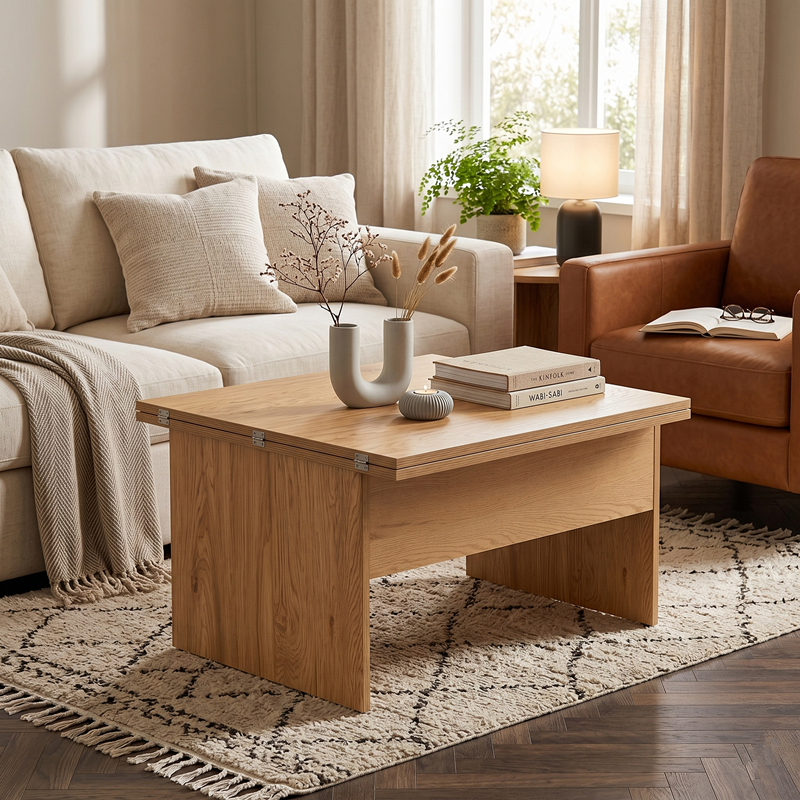
In addition, solid wood furniture often weighs more. A typical oak modern coffee table may weigh 25–35% more than an MDF version, increasing shipping costs for international distribution.
For this reason, solid wood is often reserved for high-end collections.
Particle Board: Cost Efficient for Large Volume Products
Particle board is commonly used in entry-level furniture production.
For large-volume coffee table programs, particle board offers:
low material cost
good compatibility with melamine finishes
stable supply chain availability
Many entry-level black coffee table and round coffee table designs use laminated particle board panels combined with steel frames.
However, particle board typically has lower screw holding strength than MDF. Manufacturers often compensate by increasing panel thickness or adding structural reinforcement in marble coffee table designs.
Top Coffee Table Design Trends for 2026
Several design trends are shaping the future of coffee table products.
1. Multi-Functional Storage
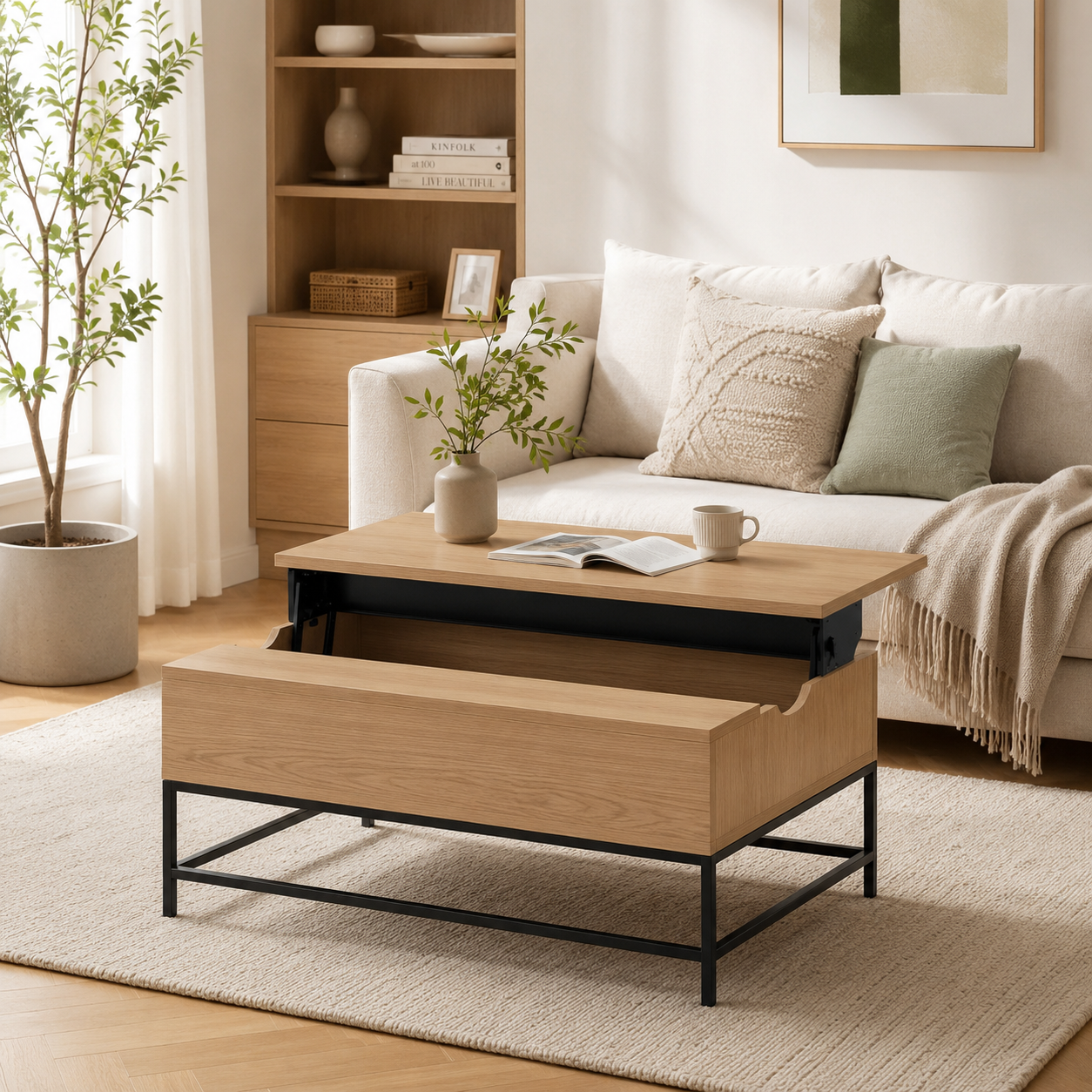
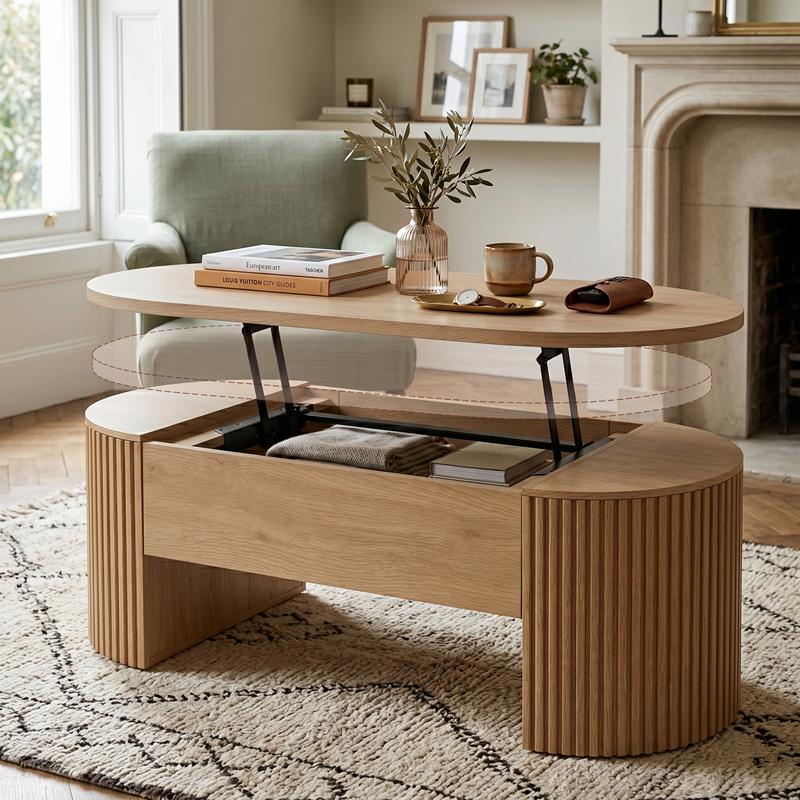
Modern consumers increasingly prefer a modern coffee table with shelves or hidden storage.
2. Compact Round Designs
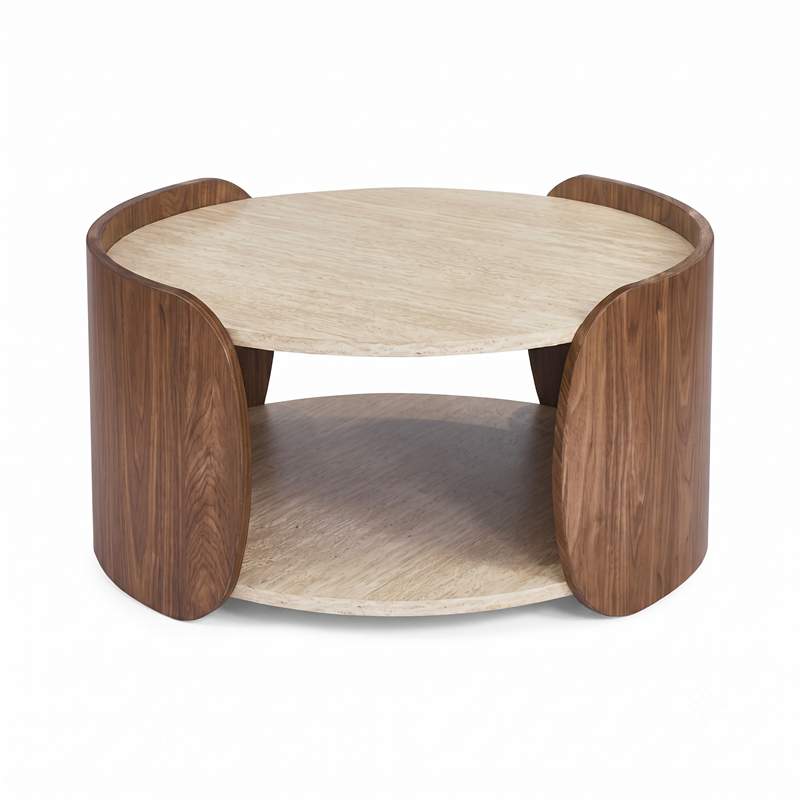
The round coffee table continues to grow in popularity because it saves space and improves traffic flow in smaller living rooms.
3. Matte Black Industrial Style
The black coffee table with steel frame and wood panel remains one of the most popular styles in North America and Europe.
4. Marble-Look Surfaces
The marble coffee table aesthetic remains a strong trend, especially when combined with minimalist metal frames.
5. Lightweight E-commerce Friendly Structures
Retailers prefer coffee table designs optimized for flat-pack shipping and easy assembly.
Coffee Table Material Selection Checklist (For Importers)
When sourcing a coffee table, professional buyers typically evaluate:
1. Weight vs Shipping Cost
A round coffee table weighing 8–12 kg is ideal for parcel shipping.
2. Surface Finish Durability
A black coffee table should pass at least 500–800 abrasion cycles for melamine surfaces.
3. Structural Stability
A well-designed modern coffee table should support 40–60 kg load capacity.
4. Packaging Efficiency
Flat-pack coffee table designs can reduce shipping volume by 30–40%.
Product Development Tips for Furniture Sellers
For many furniture brands, the most successful coffee table products combine multiple materials.
A typical modern coffee table structure includes:
MDF tabletop
powder-coated steel frame
optional storage shelf
This hybrid structure allows manufacturers to maintain durability while controlling costs.
For example, a round coffee table with MDF top and steel frame usually weighs 10 kg ±2 kg, making it ideal for e-commerce shipping.
Similarly, a black coffee table with marble-pattern laminate can deliver the visual appeal of a marble coffee table without the cost and shipping challenges of natural stone.
Each material—MDF, solid wood, and particle board—plays a different role in the coffee table market.
MDF is the most versatile material for modern coffee table designs.
Solid wood offers premium value for high-end collections.
Particle board enables competitive pricing for large-volume products.
For furniture brands and importers, selecting the right material combination is essential when developing successful round coffee table, black coffee table, or marble coffee table collections.
If you are planning new coffee table collections for upcoming seasons, selecting the right materials and structure can significantly improve cost efficiency and market competitiveness.
Well-designed modern coffee table products that balance appearance, durability, and shipping efficiency often achieve the best results in global furniture markets.