
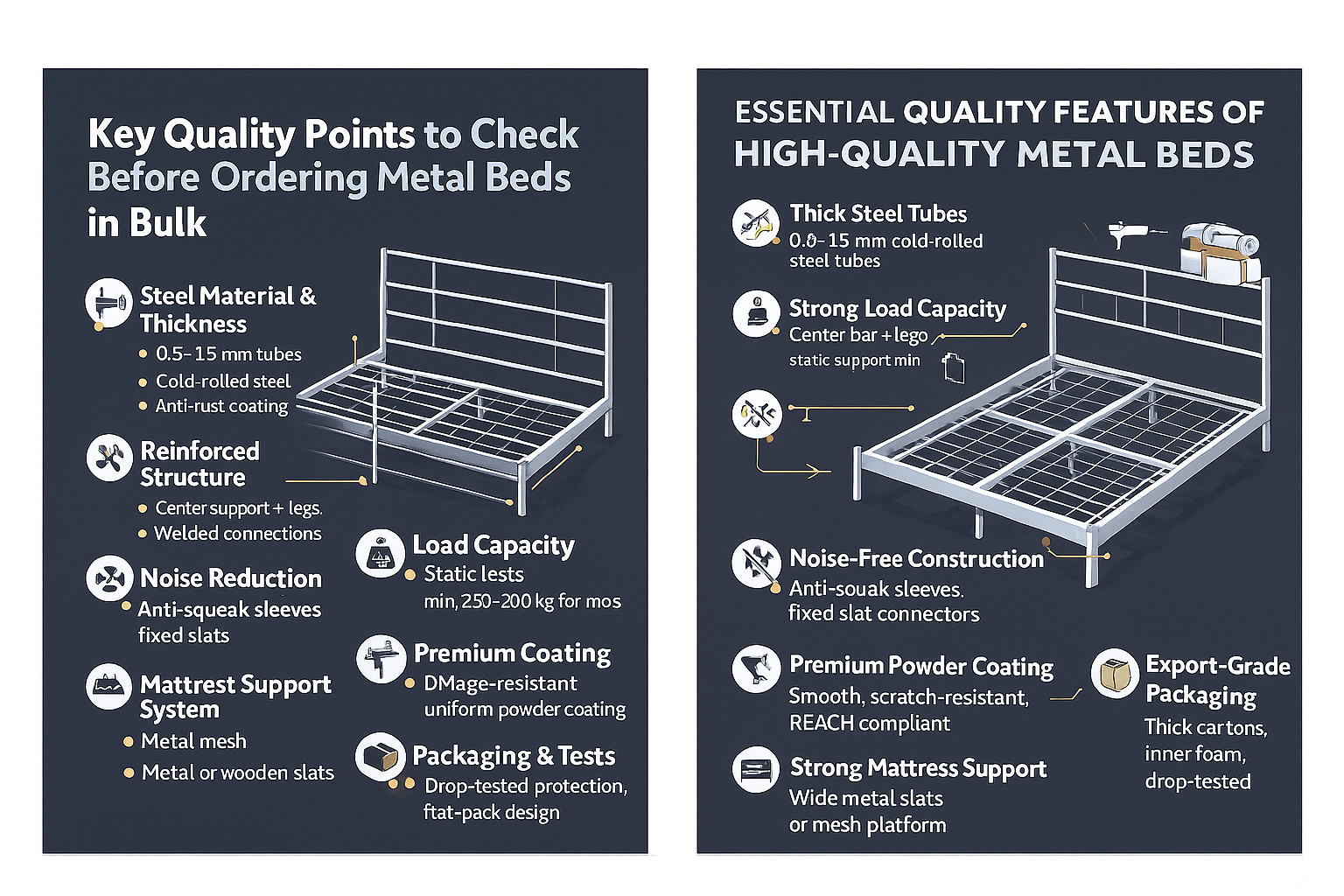
As metal beds continue to dominate international furniture markets—especially in Europe, North America, and Southeast Asia—bulk buyers must understand how to evaluate quality before placing large orders. Whether you are an importer, wholesaler, or e-commerce brand, the quality checkpoints you verify upfront will directly impact your margins, customer reviews, and long-term supplier partnership.
Here are the essential quality points every buyer should check before confirming a bulk order.
1. Steel Material and Thickness
The foundation of every metal bed is the steel itself.
What to check:
Tube wall thickness:
Standard frames: 0.8–1.2 mm
Heavy-duty frames: 1.2–1.5 mm
Steel grade: high-quality cold-rolled steel
Rust prevention: phosphating + uniform powder coating
Consistency: same steel thickness across all bars
Weak or thin material is the #1 cause of instability, bending, and frame noise over time.
2. Structural Reinforcement and Load Capacity
A good design should balance aesthetics with engineering.
Look for:
Center support bar + middle legs for Full/Queen/King
Reinforced side rails with extra welding points
A stable connection between headboard, footboard, and frame
Verified static load capacity (at least 250–300 kg for household use)
This ensures long-term performance and minimizes complaints.
3. Noise-Free Construction
Noise is one of the biggest sources of bad reviews for metal beds—especially on Amazon and Wayfair.
Quality indicators:
Anti-noise rubber or plastic sleeves at metal-to-metal contact points
Fixed slats that do not shift during use
Tight screw connections that don’t loosen easily
Brackets that eliminate structural shaking
A truly silent frame is always a bestseller.
4. Mattress Support System
The mattress support determines comfort and durability.
Options:
Metal mesh platform: strong, heavy-duty
Metal slats: balanced support, very stable
Wooden slats: flexible and comfortable, but packaging-sensitive
What to check:
Slat distance consistency
Proper fixation to avoid noise
Adequate number of slats for your market standard
Poor support leads to sagging mattresses and early returns.
5. Surface Treatment & Powder Coating
A premium appearance often reflects premium workmanship.
Inspect:
Smooth, even powder coating
No scratches, bubbles, or “orange peel” texture
Low smell (REACH or RoHS compliant)
Color consistency across all components
High-quality coating protects against rust and enhances aesthetics for modern homes.
6. Hardware & Assembly Experience
In bulk orders, assembly quality directly affects the customer’s experience and review rating.
High-quality indicators:
Pre-drilled holes aligned perfectly
Hardware packs sorted and labeled
Spare screws included
Assembly instructions clear and multilingual
Assembly time under 20–30 minutes
Easy assembly = fewer returns + happier customers.
7. Packaging Strength and Drop Test
Packaging determines whether the bed arrives safely—especially for e-commerce.
Confirm:
Strong K-grade export cartons
Corner protectors, foam blocks, and protective wrapping
ISTA-certified drop test results
Clear labels and barcodes
Flat-pack design optimized for container loading
Good packaging reduces logistics risk and protects your margins.
8. Compliance and Documentation
For Europe and North America, certifications can be mandatory.
Ask for:
REACH compliance (chemical safety)
RoHS compliance
FSC certification for wooden slats (if used)
Load-testing reports
Full material specification sheets
A reliable supplier should provide documents proactively.
9. Supplier Capacity and Stability
Even the best samples are meaningless if the factory cannot deliver consistent quality.
Evaluate:
Monthly production capacity
Peak-season ability
OEM/ODM development capability
Their export experience in your target market
Response speed during sampling & negotiation
Choosing the right supplier is often more important than the product itself.
Bulk metal bed orders require careful evaluation across material, structure, coating, assembly, packaging, and supplier reliability. By checking these key quality points, buyers can significantly reduce risk, minimize after-sales issues, and build sustainable product lines that perform well across global markets.