
Open Shoe Rack or Closed Shoe Cabinet? What Works Better in a Small Entryway
Entryway storage looks simple until the product has to work in a real home. Shoes vary in length and height. Hallways are often narrow. Wet footwear needs air, while everyday clutter is usually better hidden. A design that solves one of these problems can easily create another.
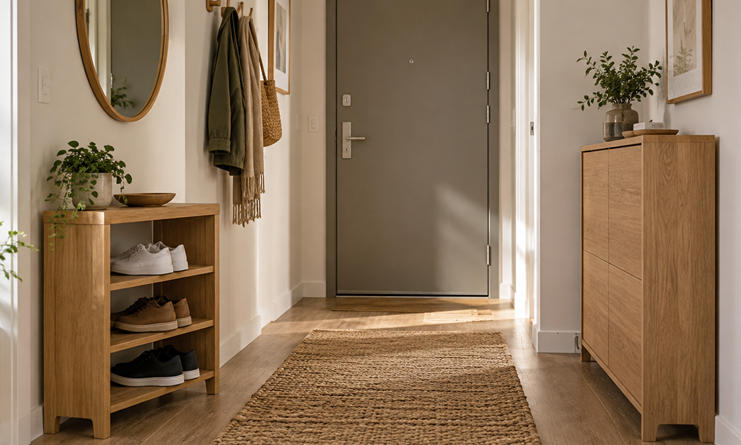
That is why the choice between open shoe racks and a closed shoe cabinet should not begin with appearance alone. It should begin with the target household, the available depth and the way people actually remove and store their shoes.
Open storage is fast, but it stays visible
An open rack is easy to understand. Customers can see the available tiers, place shoes without opening a door and quickly take the pair they use every day. For families, children or busy entrance areas, that low-effort action can be more useful than an elaborate storage mechanism.
Open shoe racks also allow more air to circulate around recently worn footwear. This does not remove the need for cleaning or drying, but it avoids enclosing every pair immediately after use. From a product-development point of view, the structure is normally easier to explain in one ecommerce image and may require fewer moving parts.
The trade-off is visual. Shoes of different colors and sizes become part of the room. Even a neatly designed rack can look untidy when some pairs extend past the shelf or when the top tier starts collecting bags, keys and parcels. The product may be compact, yet the entryway can still feel busy.
A closed cabinet creates calm, but the inside must be realistic
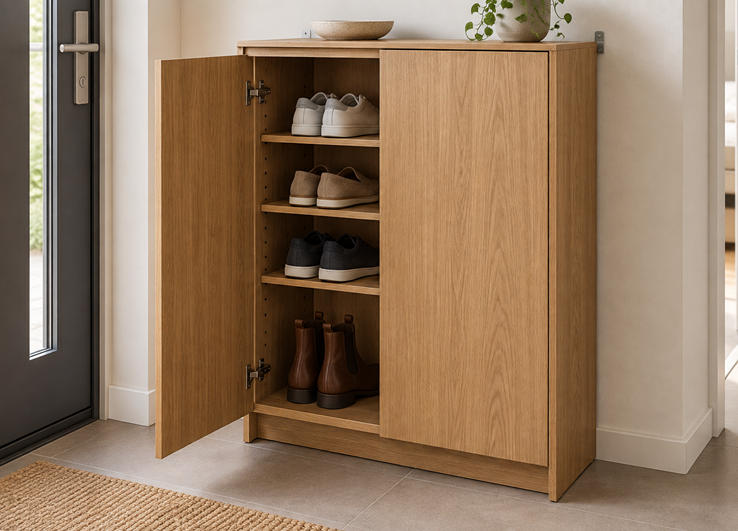
A closed shoe cabinet removes that visual interruption. When the doors are shut, the entrance reads as a furnished space rather than a storage zone. This is one reason current entryway design is moving closer to console furniture: clean fronts, warm wood finishes and restrained handles help storage sit naturally with mirrors, coat hooks and other hallway pieces.
But a clean exterior does not guarantee useful storage. Internal depth, shelf spacing and door movement determine which shoes actually fit. Product capacity should never be calculated only with low-profile footwear. Trainers, larger men's sizes, ankle boots and shoes with thick soles can change the result quickly.
A good shoe storage cabinet therefore needs a clear footwear assumption. Are the shelves intended mainly for flat shoes? Can one shelf be adjusted or removed? Does a tilt-out compartment accept longer shoes without pressing against the door? These details are more useful to buyers than a large pair-count claim without context.
Depth is not just a specification
For a narrow hallway, every extra centimeter affects circulation. A very shallow cabinet can preserve walking space, but it may need angled shelves or tilt-out compartments. That changes the way shoes sit inside and may limit the footwear types the product can hold.
A deeper cabinet offers more conventional shelf storage and can accommodate a wider mix of shoes. It also projects farther into the entrance. The right depth is not automatically the smallest possible number. It is the shallowest construction that still supports the intended footwear and keeps the product stable.
Wall fixing should be considered early, particularly with tall or shallow products and cabinets that open forward. It should not be treated as a last-minute instruction-manual detail. Door weight, loaded shelves, base design and anti-tip requirements all influence the final structure.
When does a wooden shoe rack make more sense?
A wooden shoe rack works well when immediate access, simple assembly and open ventilation are more important than concealing every pair. The material and finish can help it feel warmer and more residential than a basic utility rack. Still, wood alone does not make the design suitable for an entryway.
Shelf spacing should account for the toe and heel profile of real shoes. Edges need to be easy to clean. The lower shelf should not sit so close to the floor that cleaning underneath becomes difficult, unless the product is intentionally designed with a closed plinth.
Some sourcing briefs and keyword lists use the phrase shoe rack wooden. It is useful as an exact search term, but wooden shoe rack is the more natural expression in customer-facing English. Keeping that distinction prevents SEO language from making the article or product page sound machine-written.
Mixed storage can solve the daily-use problem
The decision does not always need to be completely open or completely closed. A small open section can hold the pairs used that day, while doors hide the rest. A bench can add a place to sit, provided the seat height, load-bearing structure and overall depth are appropriate. A narrow drawer can organize keys or shoe-care items without turning the unit into a general-purpose cabinet.
This mixed approach is useful, but each extra function should earn its place. Adding a seat increases structural requirements. Adding a drawer takes space away from footwear. Adding too many front divisions can make a compact unit look visually heavy. The strongest design is often the one that solves the main entryway problem with the fewest complications.
What online furniture buyers should check
Before approving a rack or cabinet for development, we recommend checking a short list of practical questions:
Which shoe sizes and footwear types define the internal layout?
Is the quoted capacity based on realistic shelf spacing?
Can frequently used shoes be stored without several extra actions?
Does the open or closed design match the target customer's tolerance for visible clutter?
Will the door or tilt-out mechanism reduce hallway clearance during use?
Does the product require wall fixing, and is that requirement clearly communicated?
Can ventilation, cleaning and odor management be addressed without weakening the exterior design?
Are the assembly method and packaging suitable for the intended sales channel?
These checks also improve the product page. When dimensions, usable depth, shelf adjustment and suitable footwear are clearly shown, customers do not have to guess whether the product will work in their entrance.
The better product is the one that fits the routine
Open storage is not automatically basic, and closed storage is not automatically more premium. A rack can be the better answer for quick daily access. A cabinet can be the better answer when visual calm and concealed capacity matter most. In many homes, a carefully balanced combination works better than either extreme.
For Deluxstar, developing a shoe storage cabinet starts with the footwear mix, target depth, door action and product positioning—not only the number of pairs listed in the specification. If you are developing entryway furniture for an online brand, importer or retail collection, send us your reference image, target dimensions and preferred storage format. We can review the proportions, internal layout, material direction, assembly and packaging requirements together.